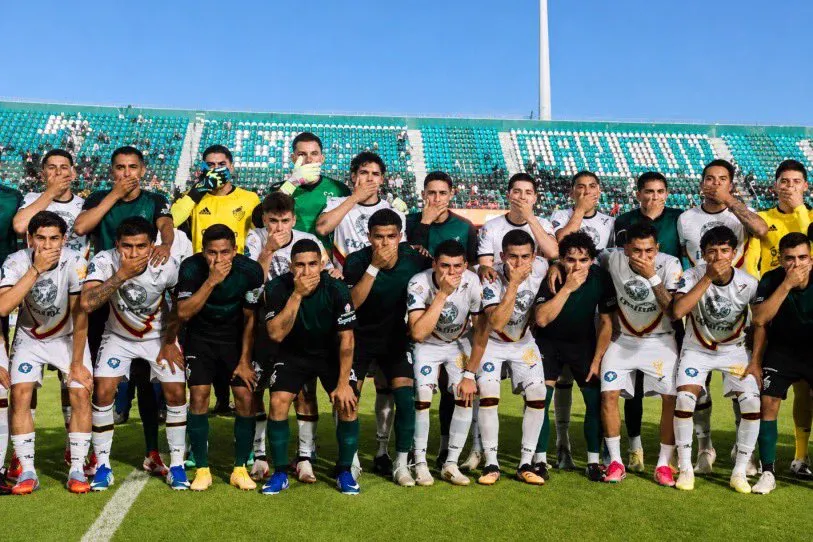
To say there is money to be made in sports is an enormous understatement. But for every dollar raked in by the juggernauts of world soccer, dozens of other clubs desperately struggle to stay afloat—especially those with financial futures so bleak that only Hollywood stars have the capital to drag them back to respectability.
For teams lucky enough to play within a promotion and relegation (pro/rel) system, financial salvation can be earned on the pitch. Soccer clubs outside of that structure, however, are stuck spinning their wheels in perpetual debt, without a clear path or motivation to move forward.
In Mexico, pro/rel thrived for nearly 70 years before the country converted to a static, closed-league model similar to the traditional North American sports system. While suspending and quietly killing off pro/rel worked out well for the incumbents in Liga MX—a league with a bright future on the international stage—those trapped in the second division and below are left stranded. Without a way to climb back up to the top tier, they are now destined to rot away in football purgatory.
A Temporary Model Change or a Makeshift Monopoly?
Seventy years of Mexican soccer tradition did not just vanish overnight. In hindsight, the warning signs of financial implosion and a monopolistic takeover were blatantly obvious.
In May 2019, the Federación Mexicana de Fútbol Asociación (FMF) mandated that second-division champions must be certified to earn promotion—requiring clubs to meet strict financial, infrastructure, and stadium criteria. Uncertified champions were denied promotion and given roughly $2 million in compensation instead. While a nice cash influx, it paled in comparison to the revenue generated by a spot in the top flight.
Then, during an FMF General Assembly held via videoconference on April 24, 2020—with Liga MX, the Circuito de Plata (formerly Ascenso MX), Liga Premier, Tercera División, and the amateur sector represented—the assembly unanimously agreed to suspend pro/rel for six seasons (2020–21 through 2025–26). The assembly enacted five key rule changes:
- Ascenso MX Dissolved: The Clausura 2020 season was canceled with no champion declared.
- Development Focus: The replacement competition, Liga de Expansión MX, was designed as a development league weighted toward under-23 players.
- Pro/Rel Frozen: Promotion and relegation were frozen in both directions.
- Youth Minutes Rule Scrapped: The 20/11 rule requiring Liga MX clubs to give minutes to under-21 players was abolished.
- Monetized Relegation: Sporting relegation was replaced by a financial compensation scheme.
This final change effectively monetized relegation through a sliding penalty scale levied on underperforming clubs. Liga MX committed 240 million pesos per year for six seasons, funded directly by fines on bottom-tier finishers:
- 120 million pesos for last place
- 70 million pesos for second-to-last
- 50 million pesos for third-to-last
In another suspicious sidestep, the assembly permanently suspended the system without amending the statutory provisions that granted the right in the first place, raising serious questions about whether the federation had the authority to wield the ax. The FMF's position was partially upheld at the sports-jurisdiction level when the panel in Club Atlético La Paz v. FMF (TAS 2025/A/11442) noted that the legality of the April 24, 2020 decision had already been settled in Venados FC v. FMF (CAS 2020/A/7090), limiting itself to interpreting what the assembly actually agreed to.
However, a competition regulator is not bound by CAS awards. A horizontal agreement among 18 incumbent clubs to block market entry—adopted without the internal authority to alter the rights it extinguished—presents a completely different legal issue.
The Last Attempt to Restore Promotion and Relegation
On September 14, 2026, the Comisión Nacional Antimonopolio (CNA) opened file no. IO-001-2026 to investigate the market for affiliation, organization, and access to federated professional soccer in Mexico, marking the latest attempt to restore the pre-2020 system.
Under Articles 54–56 of the Ley Federal de Competencia Económica, the CNA must first define the relevant market (Art. 58) and establish whether the incumbents hold substantial market power (Art. 59) before evaluating specific conduct. The statutory investigation runs from 30 to 120 business days and can be extended up to three times. Consequently, a formal statement of probable responsibility (dictamen de probable responsabilidad) will realistically not occur until 2027.
The investigation targets the permanent closure of promotion and relegation under Article 35 of the 2026–27 Reglamento de Competencia, framing it as an artificial barrier to entry imposed on lower-tier clubs. If the CNA finds anti-competitive practices, it can order their immediate elimination.
Two key factors set this apart:
Settled Legal Status: The respondents' status as economic agents (agentes económicos) was established in the 2021 COFECE ruling.
Non-Arbitrable Jurisdiction: The parties cannot arbitrate this dispute away. This domestic antitrust proceeding operates independently of FMF statutes and runs parallel to ongoing CAS filings.
While this might be the final attempt to save promotion and relegation in Mexico, it remains to be seen whether antitrust intervention can reinstate a open pyramid system that seemed destined to fail before these controversial corporate tactics were deployed.


