Transfer windows are cut-throat. Tottenham Hotspur witnessed this firsthand last summer with a number of missed signings, but none stung more throughout their fanbase than missing out on Morgan Gibbs-White.
A deal that, thanks to the positive reports by the likes of Fabrizio Romano, felt in the bag. Yet, to the surprise of almost everyone, Gibbs-White decided to turn his back on the truckload of money the persistently struggling Spurs drove up to his driveway, opting to stay with Nottingham Forest, a more likely relegation contender at the time.
Something felt off. Most pushed it off as football transfer windows being a chaotic beast that takes the most unexpected twists and turns. The Crystal Palace fan base saw it quite differently.
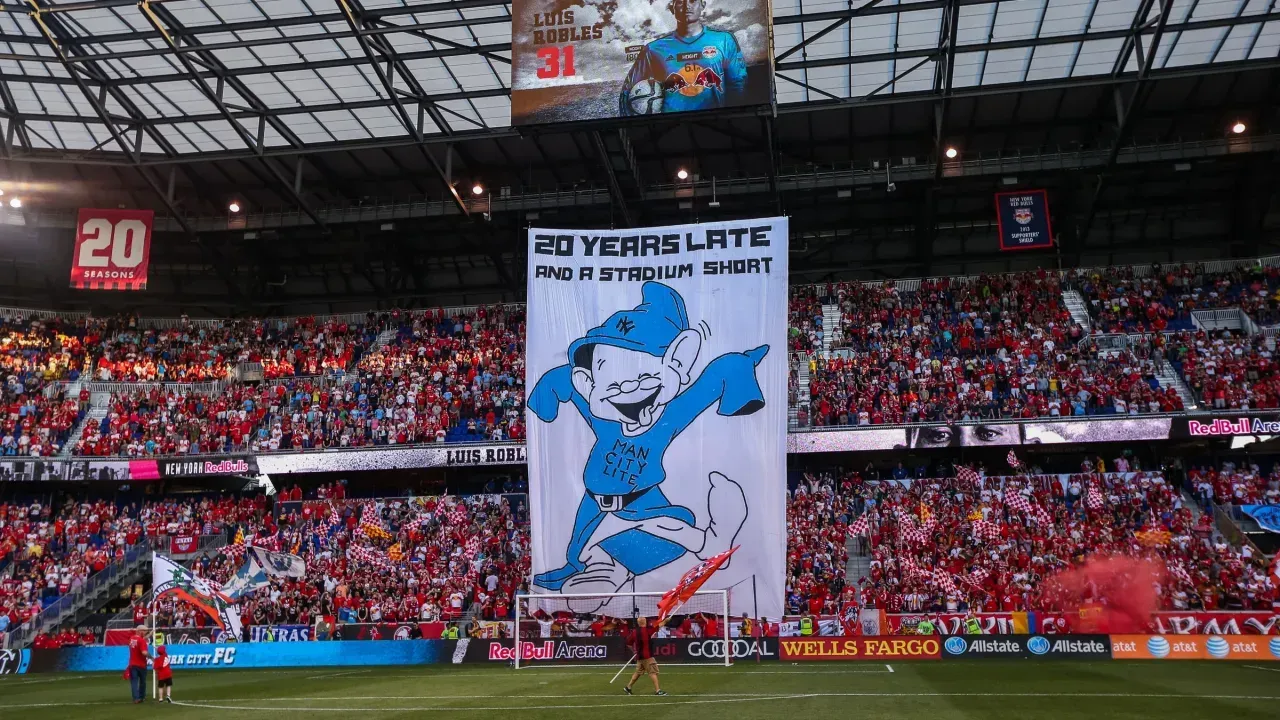
On August 24, 2025, against Nottingham Forest, Palace’s ultras in the Lower Holmesdale Road end at Selhurst Park unraveled a tantalizing tifo depicting a caricature of Evangelos Marinakis, owner of Forest and Olympiacos FC, holding a gun to the head of Gibbs-White with the tagline: "Mr Marinakis is not involved in blackmail, match-fixing, drug trafficking or corruption." Marinakis was not at the match to see the banner, but nonetheless filed a defamation claim in the High Court in London on August 10, 2026, putting him just within the one-year window to file this claim under s.4A of the Limitation Act 1980.
The FA Regulatory Commission Decision
According to the decision made by the Independent Regulatory Commission under the FA's Rules and Disciplinary Regulations, the undisputed facts are:
The banner was immediately seen by the control room, which despatched [sic] stewards to the area. The stewards were on site within about 30 seconds. The banner was voluntarily taken down within about 2 minutes. It remained on the ground in the stand until half time when it was removed.
FA’s expert report, compiled by their Safety and Security Advisor, concluded that Crystal Palace’s security measures failed, exposing “the integrity of the stadium’s search regime.” The Commission agreed with their expert’s findings, levying a £50,000 financial penalty for their security transgressions.
In its case, Palace shoehorned a free speech angle into its argument, stating that:
…it is, in any event, clearly an expression of the exercise of the right to freedom of speech from the Crystal Palace supporters, and whilst the Club acknowledges there are guardrails around freedom of expression that the Club will always police, there must be a general presumption of freedom of expression.
Although the argument would be ignored by the FA’s Committee, the sentiment still stands strong as this case moves further through the legal system. If the High Court in London runs with this fact pattern, or if they dig out and find the true culprits, it will unravel over the next few months. But Palace looks to have some law working in its favor, in and out of the UK.
Defamation or Freedom of Speech
Throughout the world, various lines have been drawn to determine where freedom of speech ends and where defamation of a person’s character begins. Generally, the person who publishes or puts the message out to the public will be held liable. However, when that person is not readily found, the organization that displayed the message, whether knowingly or unknowingly, is usually drawn into the claim for allowing it to reach additional eyes. But this has its limits. In England, section 10 of the Defamation Act 2013 governs, which reads:
a court does not have jurisdiction to hear and determine an action for defamation brought against a person who was not the author, editor or publisher of the statement complained of, unless the court is satisfied that it is not reasonably practicable for an action to be brought against the author, editor or publisher. Defamation Act 2013, s 10 (Eng. & Wales)
Since Palace is not the author, editor, or commercial publisher of the tifo, the language from this Act can, in theory, strip the court’s jurisdiction over Palace if the court finds that it is not reasonably practicable to sue one of the banner smugglers who created and published the cruel caricatures. Palace will likely argue that the authors are identifiable through CCTV and ticketing, making them reasonably available to apprehend and serve for a lawsuit, which fully explains Marinakis’ inclusion of “Persons Unknown” as a defendant in the complaint, forcing the club to disclose the identities of its own supporters to sidestep further liability.
Football fan speech, although not in banner form, has been litigated and determined to be defamatory in the past. The closest English case dealing with a similar matter is the Blackpool litigation of 2014–2016, when Owen and Karl Oyston sued their own supporters over online criticism of the club’s management.
Karl Oyston recovered a £30,000 judgment from Stephen Reed thanks to the High Court in Manchester over a Back Henry Street posting alleging he had brandished a gun and assaulted Reed. That followed an earlier award of £20,000 each to Owen and Karl Oyston against David Ragozzino over sexual-misconduct and corruption allegations posted on Another View From the Tower, a club forum.
When the Oystons and Blackpool FC sued Paul Crashley, who ran another forum called Back Henry Street, for £150,000 over six derogatory comments about the owners and the club, that action was struck out. The key point in this case that Palace will seek to replay is that claims against the individual speakers succeeded, while the claim against the party that merely provided the space collapsed. However, this case differs in that Blackpool FC appeared as a claimant, never as a defendant. In fact, an English case has yet to treat a club as publisher of its supporters’ speech. An uphill battle Marinakis will have to trudge through before eventually identifying the real parties he hopes to collect from Palace’s security cameras.
Fans being held accountable for their defamatory statements during soccer matches are reaching new legal levels across Europe.
In 2022, during a La Liga match between Real Valladolid and Real Madrid, five fans hurled racist insults aimed at Vinícius Júnior, which the Provincial Court of Valladolid found enough to convict them for a hate crime in accordance with art. 510.2(a) of the Spanish Penal Code. Less than a year later, hours before a Copa del Rey tie between Real Madrid and Atlético de Madrid, four men hung a mannequin dressed in Vinícius Júnior's shirt by the neck from a motorway bridge near Real Madrid's Valdebebas training ground, alongside a banner reading "Madrid hates Real." Police arrested four members of Frente Atlético, an Atlético ultra group, shortly thereafter. All four were convicted of hate crimes.
In Italy, fan behavior became so toxic that the Federazione Italiana Giuoco Calcio, the Italian Football Federation counterpart to the FA, decided to handle unruly ultras’ banners rather than clog the legal system with civil suits. Across Europe, this pattern seems consistent: these tasteless tifos are criminal or regulatory acts, not a tort.
Looking stateside, Marinakis’s claim would have serious hurdles to jump as well, thanks to New York Times v. Sullivan, 376 U.S. 254 (1964), the United States’ main defamation case law, requiring actual malice when dealing with a public figure, which Marinakis could very well qualify. Additionally, Palace’s prompt removal of the banner would shoot any failure-to-remove theory straight out of the water.
At the end of the day, Crystal Palace will just want to be dismissed from this case without incurring any further liability. However, while surrendering your fans' identities might be the business-minded path, finding a way to stick it to a football owner who brings nothing but shade wherever he goes would certainly be a righteous one, especially from a Spurs fan's point of view.