There is an epic scene in the movie Zoolander where Ben Stiller’s character, Derek Zoolander, challenges Owen Wilson’s character, Hansel McDonald, to a “walk off.” As the two male models strut off to prepare for their nonsensical battle, Billy Zane, playing himself, deftly declares to all bystanders with exhilarating exuberance:
“It’s a Walk Off!!”
Everyone in attendance at the warehouse party can’t help but turn their attention to this scene and meander their way over to witness the spectacle that is about to occur.
When soccer teams walk off a pitch, whether in unison or dissension, it tends to create the same feverish fervor and confusion amongst fans witnessing the protest unfold.
What’s happening? Is one team forfeiting? Can they just walk off the field for any amount of time and return to finish the game without any repercussions?
Most football followers are aware that this abnormal event occurred earlier this year during the AFCON Championship Game between Senegal and Morocco. The aftermath of which has found its way deep into the appeals process, with a Court of Arbitration for Sport (CAS) decision looking to formally crown the African Champions almost a year after the final whistle of the contest blew.
But, with a bevy of previous decisions and conflicting language on “walk-offs” to choose from, does CAS have enough statutory language and judicial prowess to award a team a championship after the Confederation of African Football’s (CAF) decided to strip the title from Senegal?
The Game and the CAF Decision
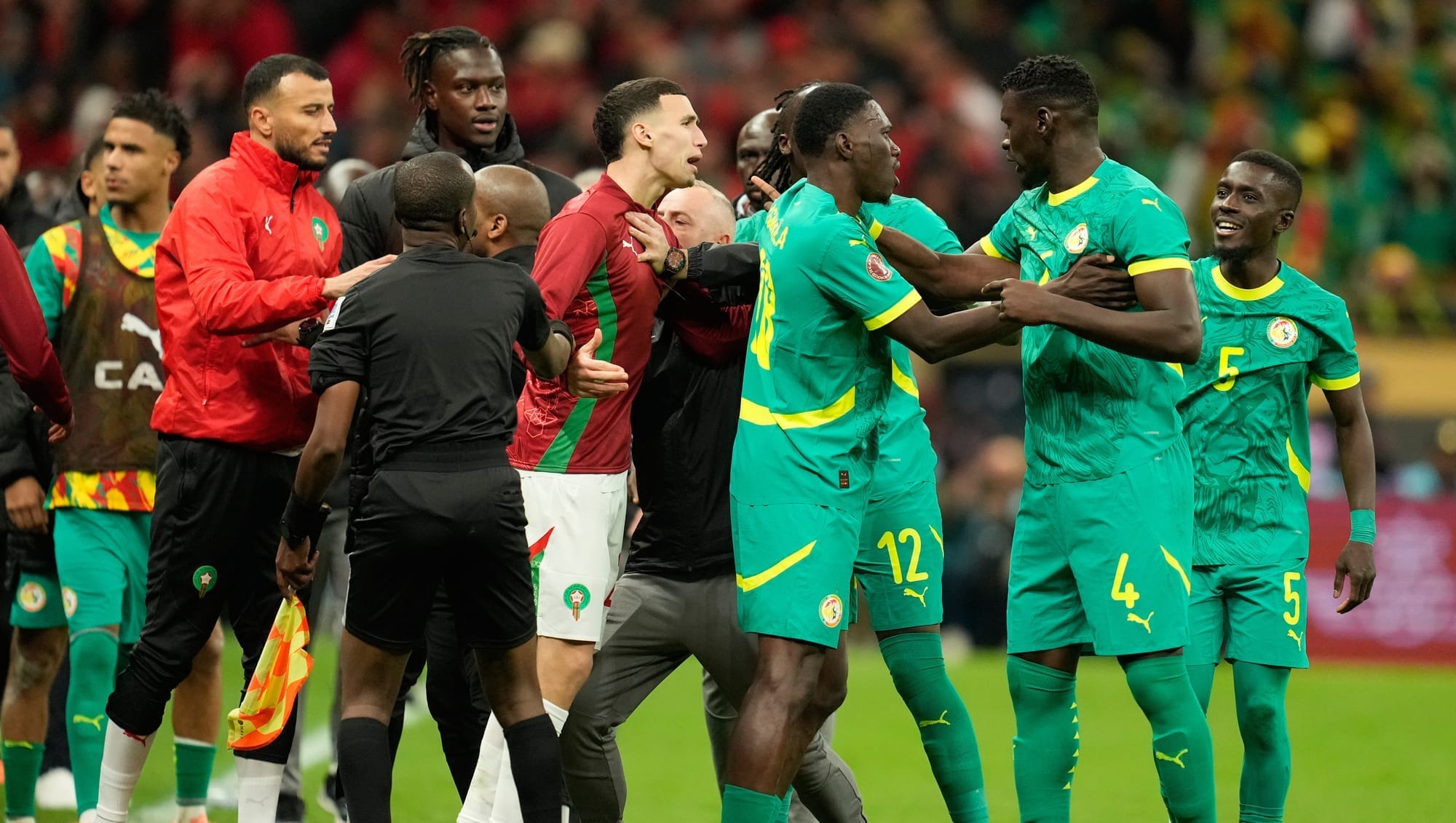
Because it was such an outrageous act during such a highly profiled football match, the game itself has been well dissected throughout the media. To condense the matter into a few sentences: in stoppage time, VAR awarded a penalty kick to Morocco that Senegal vehemently disagreed with; their coaches and players walked off the field, creating roughly a 17-minute delay; Senegal’s goalie Edouard Mendy ended up easily saving the penalty after the players returned; and Pape Gueye, the Teranga Lions’ center midfielder, scored the game-winning goal for Senegal in extra time.
Bedlam barely describes the scenes that occurred on the field. But everyone knew that in this day and age it couldn’t, nay wouldn’t, just end there. A circus of frenzied events would fly around the soccer-verse over the following months, with legal decisions that, if they stand, will reverberate shockwaves on how football competitions structure the language of their tournament rules and regulations to avoid future similar confrontations.
The CAF Disciplinary Board's First Ruling in late Jan 2026 would do little to calm the anger and confusion of the bystanders anxiously watching this train wreck enter its second stage. The initial court action only levied fines exceeding $1M, suspended both sides, and left the result unchanged.
In March, CAF’s Appeal Board, in a shocking move, reversed the Disciplinary Board’s ruling, citing procedural errors, claiming that Morocco’s “right to be heard had not been respected during the initial proceedings”, siding with the Fédération Royale Marocaine de Football’s earlier protest invoking Articles 82 and 84 of the AFCON tournament rules and regulations regarding misconduct and match forfeiture.
And just like that, Senegal was stripped of its Africa Cup of Nations 2025 title. A dark day in sports history? Or a rightful decision after an on-field tantrum that was handled poorly on the pitch?
Abdoulaye Seydou Sow, secretary general of the Senegalese Football Federation, told Radiodiffusion Télévision Sénégalaise, "We will not back down. The law is on our side." They wasted no time filing an appeal with CAS, an opinion that, in all intents and purposes, will crown the AFCON champ
Jiving CAF’s Tournament Rules and Decisions with CAS’s Field of Fair Play Precedents
Elevating this case up to CAS was inevitable, but now that it is in front of the international court, the panel will have to decipher how to co-mingle CAF's tournament regulation with their previous decisions on team walk-offs.
The best place to start this labyrinth is with the tournament’s rules governing the game. The CAF official regulations designated specific language on how to handle matches where a team decides to withdraw from a match, whether before it starts or, as here, in-game. The relevant text of the code reads:
ARTICLE 82: If, for any reason whatsoever, a team withdraws from the competition or does not report for a match, or refuses to play or leaves the ground before the regular end of the match without the authorisation of the referee, it shall be considered looser [sic] and shall be eliminated for good from the current competition. The same shall apply for the teams previously disqualified by decision of CAF.
ARTICLE 84: The team which contravenes the provisions of articles 82 and 83 shall be eliminated for good from the competition. This team will lose its match by 3-0 unless the opponent has scored a more advantageous result at the time when the match was interrupted, in this case this score will be maintained. The Organising Committee may adopt further measures.
The CAF Disciplinary Code also addresses abandonment of games by teams mid-game, stating:
Article 148 ABANDONMENT: 1. If a team refuses to play a match or to continue playing one which it has begun, it will be sanctioned with a minimum fine of ten thousand USD (10,000$) and will, in principle, forfeit the match (cf. art. 105).
Morocco will likely argue that by leaving the pitch with time still left on the clock, Senegal refused "to continue playing" a game that had already begun. By doing so, even if the game is restarted, CAF's rules state that Senegal must be sanctioned and will forfeit the match in principle.
On the flipside, a viable argument for Senegal is that although they may have left the pitch before "the regular end of the match", they never left the stadium grounds. The squad was close enough to return to the field and finish the game once called back by the referee. Allowing the game to continue despite the walk-off was a decision made solely at the discretion of Jean-Jacques Ndala Ngambo, the head referee of the match.
If the International Football Association Board's (IFAB) rules, the supposed “guardians of the laws of the game, " bear any weight, Ngambo's decision to not abandon the game and let it finish could be enough for the on-field result to stand.
Section 3.1 Number of Players of IFAB states:
If a team has fewer than seven players because one or more players has deliberately left the field of play, the referee is not obliged to stop play and the advantage may be played, but the match must not resume after the ball has gone out of play if a team does not have the minimum number of seven players.
Parlay that with Section 5.3 Powers and Duties, which states the referee has "complete discretion to stop, suspend or abandon the match for any offense committed during the match, with absolute power to stop, suspend, resume or abandon play", and Ngambo’s decision to restart play really possesses layers of teeth CAS will have to navigate if it wants to confirm CAF's ruling.
Additionally, CAS's previous attempts at adjudicating the "Field of Play Doctrine" will complicate any predictions legal pundits may conjure. One case that should weigh heavily on the minds of the Panel is Horse Sport Ireland & Cian O'Connor v. Fédération Equestre Internationale (CAS 2015/A/4208), which suggests that CAS will not intervene on decisions made by referees during their duties in good faith. In that case, the Panel stated:
There are strong sporting-based principles underlying this doctrine, including the needs for finality and to ensure the authority of the referee and match officials. Moreover, it is widely recognised that such decisions are 'best left to field officials, who are specifically trained to officiate the particular sport and are best placed, being on-site, to settle any question relating to it', and that in most cases there is no way to know what would have happened if the decision had been made differently.
They go on further to reason that:
...under established CAS jurisprudence, field of play decisions will not be overturned unless there is evidence of bad faith, arbitrariness, or a manifest error of law or misapplication of the rules...
This train of thought continued in Wydad AC v. Espérance Sportive de Tunis (CAS 2019/A/6483), where the referee, unlike in the AFCON Championship game, formally abandoned the match after a prolonged delay, and CAS upheld the resulting forfeiture. There, the Panel again sided with the judgment of the head referee to govern the rules of the game as he saw fit, stating that:
...according to constant CAS jurisprudence, field-of-play decisions are in principle not subject to review by CAS panels. Decisions on the field of play are made by referees who are appointed to enforce the rules of the game during a match. The purpose of the rule is to ensure that sporting competitions are decided on the field of play and that the finality of match results is protected.
By contrast, in the Senegal/Morocco game, Ngambo decided NOT to abandon the game and to resume play. Even more damning for Morocco, both teams agreed to finish the game. Morocco accepted the referee's decision not to abandon the game and the undesirable result by participating in the penalty shot, which they missed, and in extra time, where they failed again, on the field. Unfortunately for them, their participation likely precluded them from later seeking to undo the outcome through administrative channels.
The fact that the referee never ruled the game as abandoned and that Senegal never refused to take the field after the referee demanded that play restart should force CAS's panel to take Ngambo's on-field decision into consideration. Add on Morocco's willingness to take the field, eyes wide with a penalty shot on the horizon that could send them to the pinnacle, and CAS shouldn't have too hard a time recrowning Senegal as rightful kings of African soccer.
Because if a courtroom can start overturning outcomes on the field, expect more sore losers to flood the justice system as a way to lick their wounds.
A closed-door hearing for this case is scheduled for October 8, 2026, with a decision likely later this year.